

On the Global Launch of the Free the Migrants Campaign: Continue to Counter Rising Fascism with Working Women's Unity!
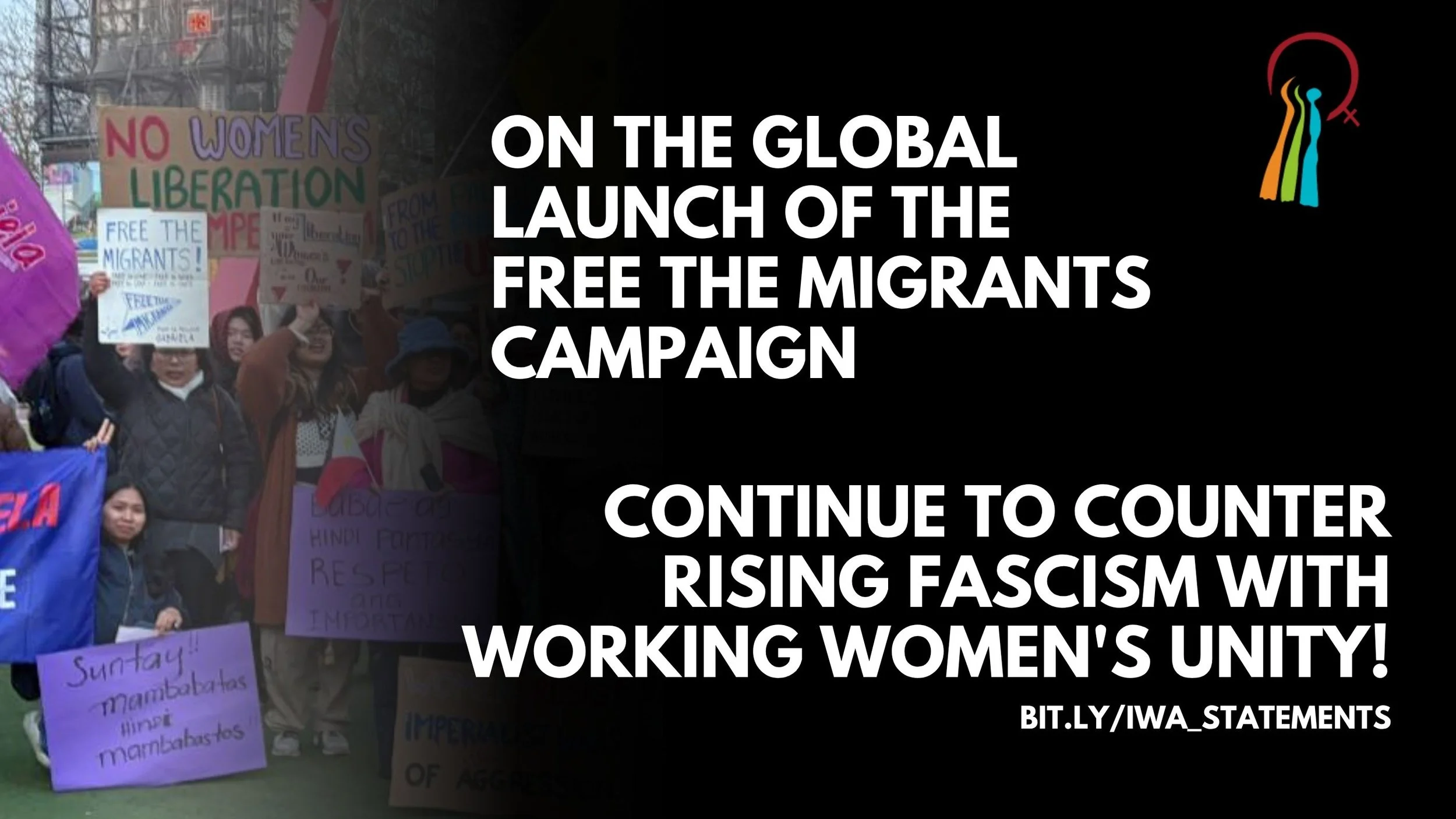
The International Women's Alliance congratulates All Workers United on the successful launch of Free the Migrants Campaign earlier this month. As IWA, we call on our members to take up this campaign as part of our Women over Profit campaign and in the spirit of our ongoing call "Counter Rising Fascism with Working Women's Unity!"
The current global situation is one of heightened war, economic crisis and the increase in neoliberal policies which is heightening the exploitative and oppressive conditions for workers and migrants today. For peasant and indigenous women, the issues of uneven development, mining, logging, land grabbing, heightening militarization and foreign dependence for agricultural imports wears away at the chance of safe and decent livelihoods which creates massive internal and international migration in search of survival. For working women, the issues of rising informal employment, neoliberal policies, union busting, targeting of union activists, rising cost of living and declining wages causes women to migrate outside of their communities looking for work abroad where they face more hardships. In turn, funneling migrant women into a reserve army of labor that provides cheap, informal, and flexible labor for capitalist economies. Often, migrant working women will take on care, agricultural, and service work that are some of the most vulnerable sectors within their host countries.
Since the outbreak of the US-led assault on Iran at the end of February the world has been plagued with increased violence and increase costs of fuel and basic goods. In a world that was already burdened by economic crisis brought about by stagnant wages and high inflation (stag-flation) the added additional costs have resulted in price-hikes that have far outpaced the wages of workers around the world. The Philippines faces the highest fuel costs in the region with diesel prices rising by 124%, gasoline by 60.5%, and liquefied petroleum gas by 44.7%. In May, Kenyan bus operators who provide most of Kenya's public transport launched a strike in response to the sharp fuel price hikes as a result of the war on Iran. Kenyan police responded with violence: killing 4, injuring 30, and arresting more than 700.
In June police in Mississippi, in the U.S., shot and killed 1-year old Kohen Wiley outside a grocery store. Kohen was accompanied by two caretakers who were accused of stealing diapers for Kohen. US social services provided to mothers and families do not cover the cost of diapers which average as much as $100 a month for a single child. Many families across the US are forced to choose between gasoline, food, rent and diapers each month because of limited social services. Protests in Mississippi have demanded accountability to police officers and have drawn attention to the criminalization of mothers and families. Bernice King shared: "We are treating items on a shelf as more valuable than a child. That is not just bad policing; it is a moral collapse.”
In Kenya, amidst rising fuel costs, government corruption, and state violence against protesters - women rallied to draw further attention to increasing rates of femicide across the country. In a statement Revolutionary Women's League of Kenya linked the high rates of femicide to the overall political and cultural crisis of Kenya and countered the mainstream narrative that high rates of femicide are an individual issue issue to women alone:
The violence directed against women does not emerge in a vacuum. It develops within a society marked by mass unemployment, deepening poverty, widening inequality, social insecurity and the commodification of human life. Women are often concentrated in the most precarious forms of labour, bear the burden of unpaid reproductive work, and are frequently pushed into conditions of dependency by material circumstances beyond their control. These conditions do not excuse violence. They reveal the social environment in which violence is reproduced and normalized. Read Full Statement here
Political crisis and economic crisis also lead to competition between countries - leading to intensifying war and conflict. These wars put already vulnerable people in more precarious conditions which increase rates of violence, economic hardship, and forced displacement. Women and children are especially vulnerable as they are not only susceptible to violence brought by wars, but are also treated as tools of war and specifically targeted in an attempt for state forces to further weaken those they are waging war against. During a cabinet meeting in June, Security Minister of the Zionist State Itamar Ben-Gvir proposed that the best tactic to weaken Hezbollah and give the Zionists an upper hand in Lebanon would be "conquering territory and killing many terrorists, but also detaining their women and youth and taking them to terrorist prisons, That's what hurts them the most." Because of the Zionist assault on Lebanon an estimated 49.3 thousand people have been internally displaced - a majority of those displaced are mothers with their children with women and girls accounting for about 52% and children under 18 accounting for 27% overall. The comments by Ben Gvir are part of his bloody legacy of attempting to normalize the use of rape and sexualized violence as a tool of genocide against the entire Palestinian people and any group that challenges Zionist rule. A recent report released by the Palestinian Feminist Collective corroborates stories and data showing that sexual and gender based violence are an institutionalized tactic of the Zionist entity in their ongoing genocide against Palestinians since pre-1948 and with rates increasing drastically since the genocide against Gaza from 2023 onward. Download full report from PFC here. Around the world, corrupt governments treat women and children as collateral when waging wars; rather than upholding international humanitarian law and ensuring civilians are protected.
As the global crises in economics and politics continue to worsen, the ruling elite of each country utilize fascist policies to try and safeguard their own interests and power; catching the most vulnerable people (workers, peasants, women, children) in their wake. Fascist attacks against migrants across the world have led to deaths in detention and forced separation but there are also impacts that are harder to quantify: such as migrants avoiding medical appointments, missing non-immigration related court hearings, or not reporting violence and harassment for fear of retaliation. One such example is that of pregnant Haitian migrants in the Dominican Republic who have been avoiding giving birth in hospitals for fear of being detained and deported back to Haiti. The Dominican Republic has been waging aggressive deportation campaigns, expelling thousands of Haitians who have fled a humanitarian crisis in neighboring Haiti. Pregnant Haitian women face increased risks of illness, infection or hemorrhages which are life threatening outside a medical setting. No woman deserves to be forced to give birth in the shadows, but the culture of fear created by worldwide attacks against migrants have pushed women to the edges where increased risks of violence and harm exist.
It is clear that the economic crisis and political crisis has worsened in the last years. In all of this, women workers bear the brunt, especially as migrant workers. Migrant women's particular experiences reflect the worst possible conditions of working women under the current system. It is essential that we as migrant and women workers take up action to defend ourselves and our communities against these attacks.
By uplifting the stories of working and migrant women, we are able to better address the root causes facing the majority of women globally, we are better able to envision and fight for a world where women and migrants are free; and those women who the current system has attempted to silence and diminish will be empowered to boldly wage struggles for rights, welfare, equality and fundamental change. Migrant women who come from the working and peasant classes of women all over the world are also a force for change that must be galvanized. We call on our members to follow the militancy of migrant women around the world and boldly wage campaigns against wars of aggression, corruption in puppet governments, predatory policies in imperialist institutions, and more! With the unity of working and migrant women, we can imagine genuine solutions and build an alternative system!
Free the Migrants! Onwards to Workers Liberation!
Counter Rising Fascism with Working and Migrant Women's Unity!
Working and Migrant Women Unite Against Imperialist War!
##
Con motivo del lanzamiento mundial de la campaña “Liberen a los Migrantes”: Sigamos combatiendo el auge del fascismo con la unidad de las mujeres obreras!
La Alianza Internacional de Mujeres felicita a All Workers United por el exitoso lanzamiento de la campaña "Libere a los Migrantes" a principios de este mes. Desde la IWA, hacemos un llamado a nuestros miembros para que se unan a esta campaña como parte de nuestra campaña "Las mujeres sobre el lucro" y en el espíritu de nuestro llamada corriente "Combatamos el fascismo creciente con la unidad de las obreras!"
La situación mundial actual se caracteriza por el recrudecimiento de los conflictos militares, la crisis económica y el aumento de las políticas neoliberales, lo que agrava las condiciones de explotación y opresión que enfrentan hot en día los obreros y los migrantes. Para las mujeres campesinas e indígenas, los problemas del desarrollo desigual, la minería, la tala, el acaparamiento de tierras, la creciente militarización y la dependencia de las importaciones agrícolas extranjeras merman la posibilidad de contar con medios de vida seguros y dignos, lo que genera una migración interna e internacional masiva en busca de la superviviencia. Para las mujeres obreras, los problemas del aumento del empleo informal, las políticas neoliberales, la represión sindical, la persecución de activistas sindicales, el aumento del costo de vida y la disminución de los salarios las llevan a migrar fuera de sus comunidades en busca de trabajo en el extranjero, donde enfrentan mayores dificultades. A su vez, esto canaliza a las mujeres migrantes hacia un ejército de reserva de mano de obra que proporciona trabajo barato, informal y flexible para las economías capitalistas. A menudo, las obreras migrantes asumen empleos en los sectores de cuidados, agricultura y servicios, que se encuentran entre los más vulnerables en sus países de acogida.
Desde que estalló el ataque liderado por Estados Unidos contra Irán a finales de febrero, el mundo se ha visto azotado por un aumento de la violencia y un incremento en los costos del combustible y los productos básicos. En un mundo que ya se encontraba agobiado por la crisis económica provocada por el estancamiento de los salarios y la alta inflación (estanflación), estos costos adicionales han dado lugar a aumentos de precios que han superado con creces los salarios de los obreros de todo el mundo. Filipinas enfrenta los costos de combustible más altos de la región, con un aumento del 124 % en el precio del diésel, del 60,5 % en el de la gasolina y del 44,7 % en el del gas licuado de petróleo. En mayo, los operadores de autobuses de Kenia —que proporcionan la mayor parte del transporte público del país— iniciaron una huelga en respuesta a los fuertes aumentos en los precios del combustible como consecuencia de la guerra contra Irán. La policía keniana respondió con violencia: mató a 4 personas, dejó 30 heridos y detuvo a más de 700.
En junio, la policía de Misisipi, EE. UU., disparó y mató a Kohen Wiley, de un año de edad, frente a una tienda de abarrotes. Kohen iba acompañado de dos familiares a quienes se acusó de robar pañales para él. Los servicios sociales estadounidenses que se brindan a las madres y las familias no cubren el costo de los pañales, que asciende en promedio a 100 dólares al mes por un solo niño. Muchas familias en todo EE. UU. se ven obligadas a elegir cada mes entre gasolina, comida, renta y pañales debido a los limitados servicios sociales. Las protestas en Misisipi han exigido que los agentes de policía rindan cuentas y han llamado la atención sobre la criminalización de las madres y las familias. Bernice King señaló: "Estamos tratando los artículos en un estante como si fueran más valiosos que un niño. Eso no es solo una mala actuación policial; es un colapso moral".
En Kenia, en medio del aumento de los precios del combustible, la corrupción gubernamental y la violencia estatal contra los manifestantes, las mujeres se manifestaron para llamar aún más la atención sobre las crecientes tasas de femicidio en todo el país. En un comunicado, La Liga Revolucionaria de Mujeres de Kenia relacionó las altas tasas de femicidio con la crisis política y cultural general de Kenia, refutando la narrativa de que las altas tasas de femicidio son un problema individual o un problema que afecta únicamente a las mujeres:
La violencia contra las mujeres no surge de la nada. Se desarrolla en una sociedad marcada por el desempleo masivo, la pobreza cada vez más profunda, la desigualdad cada vez mayor, la inseguridad social y la mercantilización de la vida humana. Las mujeres suelen estar concentradas en las formas de trabajo más precarias, soportan la carga del trabajo reproductivo no remunerado y, con frecuencia, se ven empujadas a situaciones de dependencia por circunstancias materiales que escapan a su control. Estas condiciones no justifican la violencia. Revelan el entorno social en el que la violencia se reproduce y se normaliza. Lee la declaración completa aquí.
Las crisis políticas y económicas también generan competencia entre países, lo que conduce a una intensificación de las guerras y los conflictos. Estas guerras colocan a las personas, que ya se encuentran en situación de vulnerabilidad, en condiciones aún más precarias, lo que aumenta los índices de violencia, las dificultades económicas y los desplazamientos forzados. Las mujeres y los niños son especialmente vulnerables, ya que no solo están expuestos a la violencia que traen consigo las guerras, sino que también son tratados como instrumentos de guerra y se convierten en objetivos específicos en un intento por parte de las fuerzas estatales de debilitar aún más a aquellos contra quienes libran la guerra. Durante una reunión del gabinete en junio, el ministro de Seguridad del Estado sionista, Itamar Ben-Gvir, propuso que la mejor táctica para debilitar a Hezbolá y darle a los sionistas una ventaja en el Líbano sería "conquistar territorio y matar a muchos terroristas, pero también detener a sus mujeres y jóvenes y llevarlos a prisiones terroristas; eso es lo que más les duele". Debido al ataque sionista contra el Líbano, se estima que 49.3 mil personas han sido desplazadas internamente; la mayoría de los desplazados son madres con sus hijos, y las mujeres y niñas representan alrededor del 52 %, mientras que los menores de 18 años representan el 27 % del total. Los comentarios de Ben-Gvir forman parte de su sangriento legado de intentar normalizar el uso de la violación y la violencia sexualizada como herramienta de genocidio contra todo el pueblo palestino y cualquier grupo que desafíe el dominio sionista. Un informe reciente publicado por el Colectivo Feminista Palestino corrobora los testimonios y datos que muestran que la violencia sexual y de género es una táctica institucionalizada de la entidad sionista en su genocidio en curso contra los palestinos desde antes de 1948, con tasas que han aumentado drásticamente desde el genocidio contra Gaza a partir de 2023. Descarga aquí el informe completo del PFC. En todo el mundo, los gobiernos corruptos tratan a las mujeres y a los niños como daños colaterales al librar guerras, en lugar de respetar el derecho internacional humanitario y garantizar la protección de la población civil.
Es evidente que la crisis económica y la crisis política se han agravado en los últimos años. En todo esto, las obreras son las que más sufren las consecuencias, especialmente las obreras migrantes. Las experiencias particulares de las mujeres migrantes reflejan las peores condiciones posibles que enfrentan las mujeres obreras bajo el sistema actual. Es fundamental que nosotras, como migrantes y mujeres obreras, tomemos medidas para defendernos a nosotras mismas y a nuestras comunidades contra estos ataques.
Al dar a conocer las historias de las mujeres obreras y migrantes, podemos abordar mejor las causas fundamentales a las que se enfrenta la mayoría de las mujeres a nivel mundial; estamos en mejores condiciones de imaginar y luchar por un mundo en el que las mujeres y los migrantes sean libres; y aquellas mujeres a quienes el sistema actual ha intentado silenciar y menospreciar se verán empoderadas para librar con valentía luchas por los derechos, el bienestar, la igualdad y un cambio fundamental. Las mujeres migrantes que provienen de las clases obreras y campesinas de todo el mundo también son una fuerza de cambio que debe ser impulsada. Hacemos un llamado a nuestras miembros a seguir el ejemplo de la militancia de las mujeres migrantes de todo el mundo y a llevar a cabo con valentía campañas contra las guerras de agresión, la corrupción en los gobiernos títeres, las políticas depredadoras de las instituciones imperialistas y mucho más! Con la unidad de las mujeres obreras y migrantes, podemos imaginar soluciones genuinas y construir un sistema alternativo!
Liberen a los migrantes! Hacia la liberación de los obreros!
Combatamos el auge del fascismo con la unidad de las mujeres obreras y migrantes!
Mujeres obreras y migrantes, únanse contra la guerra imperialista!
##