

Five years of Taliban Authority in Afghanistan: Women Refuse to Back Down!
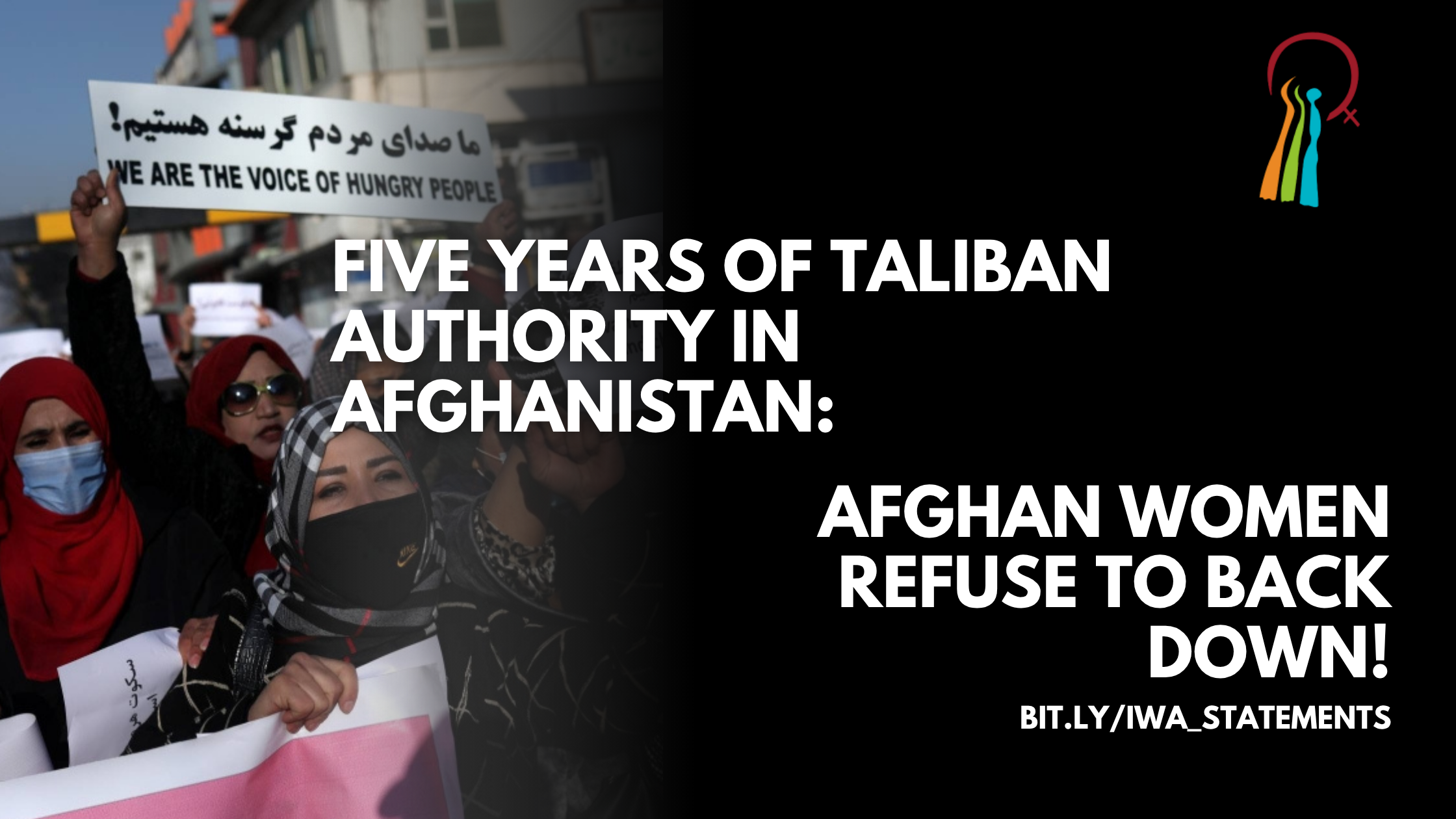
Women protest in Kabul, August 2023
Five years ago the Taliban assumed the role of de-facto authority in Afghanistan following the US's withdrawal. The International Women's Alliance recognizes the significance of August 15 as a day to honor the continued struggle of Afghan women to oppose that Taliban's repression and gender apartheid policies. Since the late 1970s, Afghanistan has been a target for US military activity and military occupation, first deploying troops in a proxy war against the USSR and then formally occupying Afghanistan in 2001 under the guise of the so-called "war-on-terror". In reality the US sought to control Afghanistan to protect its own interests in West, Central, and South Asia, as its location serves as a crossroads and trade route to the different regions - giving it political influence over the regions as well.
General support for US occupation relied on a manufactured narrative that the US' presence protected and empowered Afghan women. Within a week of the occupation of Afghanistan the New York Times editorial board praised the invasion stating that it liberated Afghan women as a “collateral benefit” of the war. While the US used women’s rights and participation in civil society as justification for spending over $2 trillion in 20 years (roughly $100 billion per year), there was no meaningful long-term improvement in women’s lives and Afghan women were left in the lurch after the US withdrew in 2021. Many women watched their rights rapidly recede as the artificial support from the US literally flew away and found themselves in a worse position than before the US first invaded. Women's long history under US involvement in Afghanistan proves that there can be no "collateral benefit" to women through imperialist led war and occupation. The only sustainable solution for women's progress is genuine change led by the most exploited and oppressed people of society.
Women in Afghanistan today face many challenges and a chronically worsening situation under the DFA. Under the Taliban's systemic approach to gender apartheid, women have lost many rights and freedoms; face economic challenges; and are at a greater risk of violence than ever before. The Taliban takeover has been marked by the introduction of laws that impacted every aspect of a woman’s life, especially rural women. The DFA relies on a culture of fear and surveillance to further restrict women’s freedoms beyond what laws are formally passed. This fear has made it extremely dangerous and precarious for women to gather together, to attend school, to seek social services, and to be involved in civil society organizations or NGOs.
The entire country of Afghanistan is in economic crisis following 43 years of US occupation and invasion – which is exacerbated by women’s exclusion from participation in the economy. A 2024 report found that only 24% of Afghan women are employed or are seeking employment compared to nearly 90% of men - primarily due to attempts the Taliban has made to remove women from public life and to relegate them to the home. Since women do not have their own source of income of institutional standing outside their husbands they are often not able to pursue domestic violence cases or report violence at home. Afghan women and children today face an uphill battle when it comes to ensuring their safety from state violence, intimate partner violence, and abuse. The Taliban was quick to dismantle the already limited infrastructure built to address violence against women – including the Ministry of Women’s Affairs and the Law on Ending Violence against Women – and further services for survivors of intimate partner violence have sharply reduced their operational scope. In 2023 the Attorney General's office was abolished, meaning there is no official state agency collecting data on the murders of women, through local reports journalists have found 231 cases of women being killed - with 165 (71%) of those being housewives who did not have a job outside the home.
Afghan women continue to prove these challenges are not insurmountable! Afghan women are far from passive and continue to show that they are a powerful force for change across the country. While the people of Afghanistan did not gain liberation under US occupation and have watched the situation worsen under the Taliban, the perspective for a better Afghan society still persists. Women defy the Taliban by confronting Taliban officials, holding protests, wearing colorful dresses and carrying the slogan: "Bread, Work, and Freedom" as their primary demand. Brave organizations of women are taking up many forms of protest and push back on the Taliban's backwards laws and norms by finding creative ways to resist, empower, and fight for an Afghanistan where women's rights are not a collateral benefit or an empty promise - but are guaranteed and protected by the government and all of society. The future of Afghanistan is a not set in stone, and the people's will and determination for justice, equality and non-discrimination will surely win in the end!
Cinco años de gobierno talibán en Afganistán: ¡Las mujeres afganas se niegan a ceder!
Hace cinco años, los talibanes asumieron el poder de facto en Afganistán tras la retirada de Estados Unidos. La Alianza Internacional de Mujeres reconoce la importancia del 15 de agosto como un día para rendir homenaje a la lucha constante de las mujeres afganas contra la represión de los talibanes y sus políticas de apartheid de género. Desde finales de la década de 1970, Afganistán ha sido blanco de la actividad militar y la ocupación de Estados Unidos, que primero desplegó tropas en una guerra por poder contra la URSS y luego ocupó formalmente Afganistán en 2001 bajo el pretexto de la llamada "guerra contra el terrorismo".
En realidad, Estados Unidos buscaba controlar Afganistán para proteger sus propios intereses en Asia Occidental, Central y Meridional, ya que su ubicación sirve como encrucijada y ruta comercial hacia las diferentes regiones, lo que le otorga también influencia política sobre ellas. El apoyo general a la ocupación estadounidense se basó en una narrativa fabricada según la cual la presencia de Estados Unidos protegía y empoderaba a las mujeres afganas. A menos de una semana de la ocupación de Afganistán, el consejo editorial del New York Times elogió la invasión afirmando que liberaba a las mujeres afganas como un "beneficio colateral" de la guerra. Si bien Estados Unidos utilizó los derechos de las mujeres y su participación en la sociedad civil como justificación para gastar más de 2 billones de dólares en 20 años (aproximadamente 100 mil millones de dólares al año), las mujeres quedaron desamparadas tras la retirada de Estados Unidos en 2021. Muchas mujeres vieron cómo sus derechos se desvanecían rápidamente a medida que el apoyo artificial de Estados Unidos, literalmente, se esfumaba, y se encontraron en una situación peor que antes de la primera invasión estadounidense. La larga historia de las mujeres bajo la intervención estadounidense en Afganistán demuestra que no puede haber ningún "beneficio colateral" para las mujeres a través de una guerra y una ocupación lideradas por el imperialismo. La única solución sostenible para el progreso de las mujeres es un cambio genuino liderado por las personas más explotadas y oprimidas de la sociedad.
Las mujeres en Afganistán se enfrentan hoy en día a numerosos desafíos y a una situación que empeora de manera crónica bajo el régimen del DFA. Debido al enfoque sistémico de los talibanes hacia el apartheid de género, las mujeres han perdido muchos derechos y libertades; enfrentan desafíos económicos; y corren un mayor riesgo de sufrir violencia que antes. La toma del poder por parte de los talibanes se ha caracterizado por la introducción de leyes que han afectado todos los aspectos de la vida de las mujeres, especialmente las de las zonas rurales. El DFA se basa en una cultura de miedo y vigilancia para restringir aún más las libertades de las mujeres, más allá de lo que establecen formalmente las leyes aprobadas. Este miedo ha hecho que sea extremadamente peligroso y precario para las mujeres reunirse, asistir a la escuela, buscar servicios sociales y participar en organizaciones de la sociedad civil u instituciones.
Todo el país de Afganistán se encuentra en crisis económica tras 43 años de ocupación e invasión por parte de Estados Unidos, una situación que se ve agravada por la exclusión de las mujeres de la participación en la economía. Un informe de 2024 reveló que solo el 24 % de las mujeres afganas están empleadas o buscan empleo, en comparación con casi el 90 % de los hombres, principalmente debido a los intentos de los talibanes por sacar a las mujeres de la vida pública y relegarlas al ámbito doméstico. Dado que las mujeres no cuentan con una fuente de ingresos propia ni con reconocimiento institucional fuera del ámbito de sus maridos, a menudo no pueden presentar denuncias por violencia doméstica ni reportar la violencia que sufren en sus hogares. Las mujeres y los niños afganos enfrentan hoy una ardua lucha para garantizar su seguridad frente a la violencia estatal, la violencia de pareja y los abusos. Los talibanes se apresuraron a desmantelar la ya limitada infraestructura creada para abordar la violencia contra las mujeres —incluidos el Ministerio de Asuntos de la Mujer y la Ley para Erradicar la Violencia contra las Mujeres— y los servicios adicionales para las sobrevivientes de violencia de pareja han reducido drásticamente su alcance operativo. En 2023 se abolió la Fiscalía General, lo que significa que no existe ningún organismo estatal oficial que recopile datos sobre los asesinatos de mujeres; a través de reportajes locales, los periodistas han identificado 231 casos de mujeres asesinadas, de las cuales 165 (71 %) eran amas de casa que no tenían un empleo fuera del hogar.
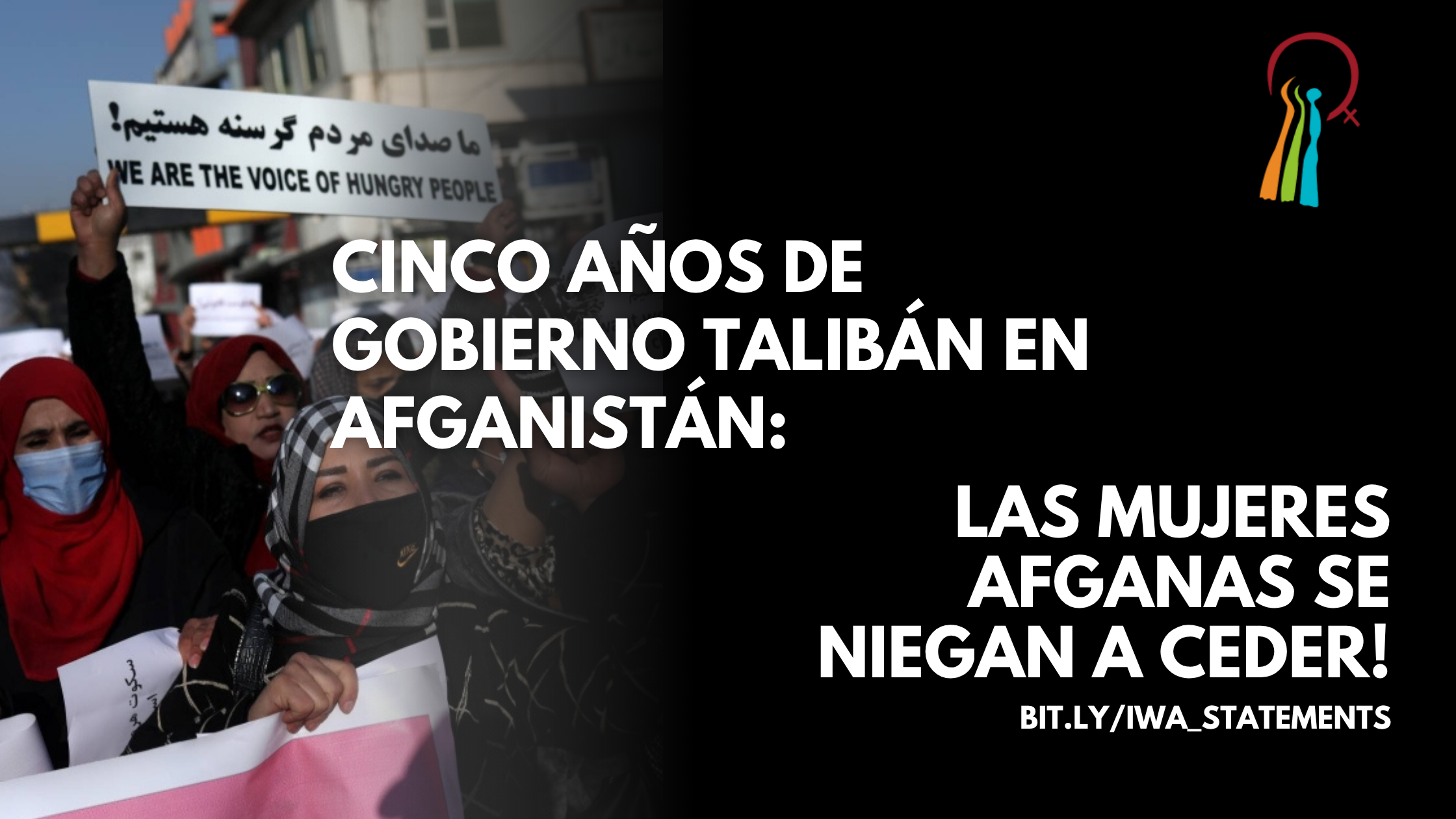
A pesar de los desafíos que las mujeres han enfrentado durante décadas de ocupación estadounidense y ahora bajo el gobierno de facto de los talibanes, las mujeres afganas están lejos de ser pasivas y siguen demostrando que son una poderosa fuerza de cambio en todo el país. Si bien el pueblo de Afganistán no logró la liberación bajo la ocupación estadounidense y ha visto cómo la situación empeora bajo el régimen talibán, la esperanza de una sociedad afgana mejor aún persiste. Las mujeres desafían a los talibanes al enfrentarse a sus funcionarios, organizar protestas, vestirse con trajes coloridos y enarbolar el lema: "Pan, trabajo y libertad" como su principal demanda. Valientes organizaciones de mujeres están adoptando diversas formas de protesta y se oponen a las leyes y normas retrógradas de los talibanes, encontrando formas creativas de resistir, empoderarse y luchar por un Afganistán donde los derechos de las mujeres no sean un beneficio colateral ni una promesa vacía, sino que estén garantizados y protegidos por el gobierno y toda la sociedad. El futuro de Afganistán no está escrito en piedra, y la voluntad y determinación del pueblo por la justicia, la igualdad y la no discriminación sin duda prevalecerán al final!