

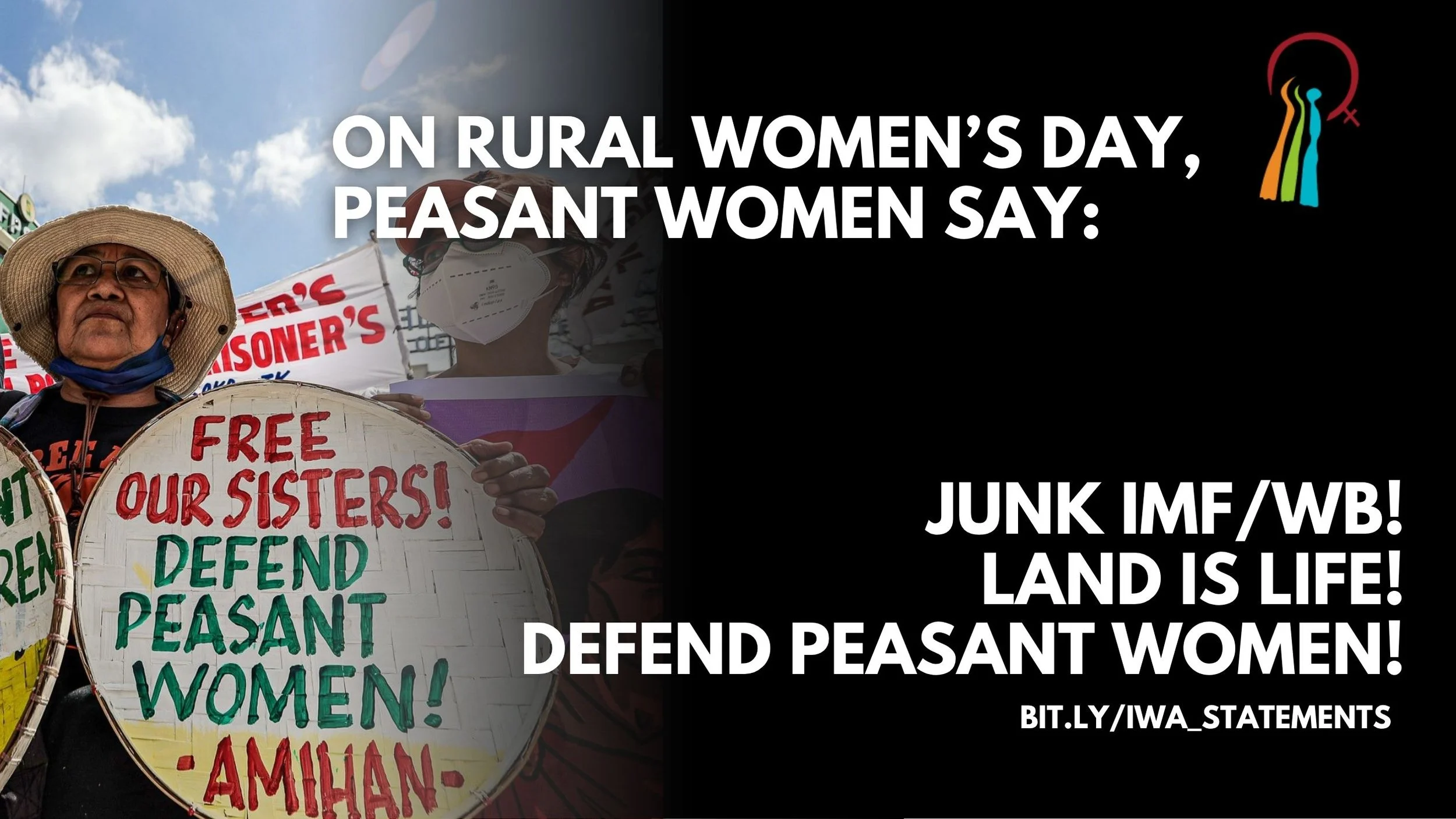
The International Women's Alliance recognizes October 15, International Rural Women's Day, as a significant day to uplift the plights and collective struggles of peasant women around the world. Peasant women represent the majority of exploited and oppressed women around the world, producing nearly 60% of the world's food while struggling to provide regular nutritious meals for them and their families. We uplift the militant struggle of peasant women and agricultural workers around the world in fighting for their land and demanding an end to predatory micro-finance programs and to expose the schemes of international finance institutions which ultimately drive more peasant women into poverty and create conditions for forced migration and family separation.
Over the last week, members of the International Women's Alliance have gathered together in Bangkok Thailand to attend various fora and activities to oppose the IMF/WB meetings. Spearheaded by the People's Global Campaign (PGC) against the IMF/WB many different political gatherings exposed the realities that peasant women and their communities face on a regular basis. It is not simply that peasant women and their families are poor, landless and hungry - instead our members learned about the centrality of IMF/WB schemes and programs which intentionally create conditions to increase the profits of countries in the global north at the expense of the majority of people in the global south. Cathy Estavillo from AMIHAN, a peasant women's organization in the Philippines, shared that peasant communities have been forced to stop using their ancestral seeds and farming practices in favor of using corporate-owned GMO seeds and fertilizers. These seeds require peasant communities to re-purchase seeds, fertilizers and pesticides year after year which slowly poisons the land and quickly causes peasant women to accumulate outsized debt and forces them deeper into poverty and hunger. The land depletion eventually forces peasant communities to have to move, leaving the land vulnerable to corporate reclamation projects and leading families to become landless and more economically vulnerable. But women continue to find ways to protect their local plants and farming practices: for example, peasant women with the organization MASIPAG in the Philippines have created a seed bank in their local barangay hall, an effort that has been replicated around the world in rural areas.
During a panel hosted by Asia Pacific Women Law and Development, Walahi - an organization. based in East Nusa Tenggara (NTT) Indonesia shared that climate finance that was injected into the community after the discovery of geothermal outputs has resulted in land reclamation, increased tourism, extraction, and infrastructure development that has caused the land to deteriorate to the point that it no longer yields a harvest that can sustain the community. Over 108 people have died in evacuation camps in NTT, and what was once a fertile region that fed entire communities has been reduced to a wasteland where women’s only options for sustaining themselves and their families are to sell firewood or to migrate to the cities or abroad.
Nearly 2,000 kilometers away from East Nusa Tenggara, Kalimantan, Indonesia is a stark example of how the long-term degradation of land in the name of "development" only causes generations of peasant women and their families to suffer. Today, fires on Mount Kalimantan have created a haze that has impacted over 10 million people - with over 187,000 experiencing acute respiratory infections which has killed many - including a 5-year-old boy in Jambi, Indonesia. Mount Kalimantan is on fire because of World-Bank funded projects from 1969 onward. Programs imposed the use of seeds, agrochemicals, and fertilizers which depleted nutrients from the earth but additional programs cleared forests for agriculture, plantations, and logging operations. The World-Bank is directly responsible for the ongoing fires and impacts of the haze across the region.
In Pakistan IMF structural debts increased costs for peasant families - these increased costs reduced the ability of peasant communities to til the land regularly and shortened their growing season, making them dependent on purchasing imported agricultural products at higher prices and driving them further into poverty. Pakistani peasant women may go days at a time without a full meal in order to ensure their children have something to eat. In the face of hunger and poverty, it is clear is that the IMF debt is being re-payed by peasant women's labor, health, and lives. The IMF has not led to any meaningful development for Pakistani communities and instead has created conditions where more peasant communities are ready to fight for genuine change together.
Additional IMF/WB programs have worked to undermine the interests of peasants and agricultural workers in rural areas around the world. In the Philippines, the World Bank's "Support to Parcelization of Lands for Individual Titling" (SPLIT) program works to undermine the genuine agrarian reforms that peasant communities have fought to win through collective struggles in confronting their exploitative landlords. SPLIT subdivides collectively held land titles into individual ones, with the stated aim of improving land tenure security and stabilizing property rights. In reality, however, SPLIT has led to concentrated land ownership in the hands of powerful economic elites who do not work the land and instead only seek to profit off of it. SPLIT shows that the programs of IMF/WB are not only profit-driven, but also seek to maintain the system as it currently is while undermining any efforts of collective resistance.
Despite generations of depleting the land and working to destroy the resolve of peasant communities to resist and fight back - peasant women continue to wage militant campaigns to ensure they have access to land, food, and natural resources. Women are the backbone of collective farming efforts which provide food and income to entire communities and effectively help to bring peasants out of poverty and hunger. Furthermore, Peasant Women refuse to stay silent, isolated, and docile. IWA was able to see the many ways that peasant women, working women, and migrant women joined together and raised their demands of genuine land reform, people-centered agricultural programs, and community driven initiatives.
What was clear throughout the PGC activities was that we cannot separate the plunder and exploitation of the land that rightfully belongs to peasants who work the land from militarization around the world. Many loan conditionalities allow for militarized and armed protection for so-called development projects - leading to increased intimidation, violence, and rape of peasant women and their communities. In rural areas around the world, development projects have become synonymous with violence, suffering, and displacement at the hands of militarized security forces.
While peasant women feed the entire world, many struggle to feed their families. If the majority of women globally are hungry - we must be driven to outrage and clamor alongside our peasant sisters to fight for genuine development, gender emancipation, and an end to rotten programs which push more women and their families to hunger. The pain of peasant women must fuel our international solidarity and our will to unite together. At the same time, the resistance and militant struggles of peasant women should encourage us to believe that another world is possible and the chains of international finance institutions are nothing more than paper which can be torn to shreds through collective action, solidarity, and coordination.
Land is life! Defend Peasant women! Junk the IMF/WB!