

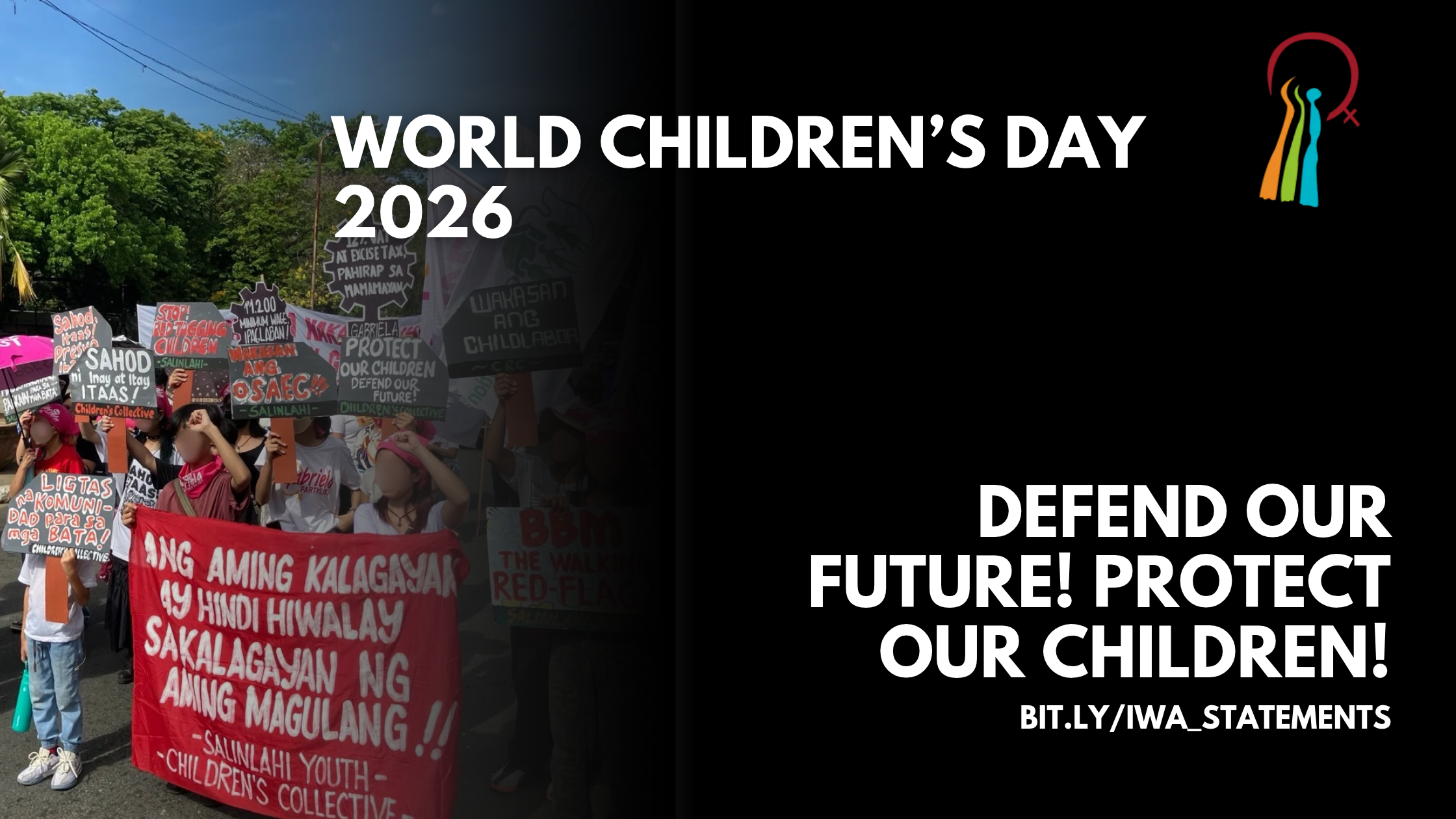
On the 72nd World Children's Day, November 20, the International Women's Alliance asserts the need to uphold the rights of children including their right to fight for their future and shape a new society! World Children’s Day (WCD), established by the United Nations and rooted in the Convention on the Rights of the Child (UNCRC), aims to promote international solidarity, raise awareness of children’s rights worldwide, and improve children’s welfare. However, we in IWA are critical about how these core objectives being achieved today. Across the globe, from Palestine and India to Colombia, Kenya, Indonesia, Nigeria, the Philippines, and beyond, children are being denied their fundamental rights and the opportunity to reach their full potential. Inter-imperialist conflicts, climate catastrophes, rising poverty, the erosion of social services, and limited access to education continue to undermine children's well-being and futures. Women and children are among the most vulnerable populations during times of crisis, yet their needs, voices, and lived experiences are too often overlooked or excluded from decision-making processes and efforts to develop meaningful solutions that address the conditions they face.
The UN Convention on the Rights of the Child identifies four fundamental pillars of children's rights: survival, development, protection, and participation. While survival, development, and protection are essential, as IWA, we assert that participation is the most important pillar in ensuring the realization of all children's rights. This World Children’s Day, in light of the realities children face today, serves as a reminder that children’s rights and welfare cannot be safeguarded by agreements alone; they must be actively defended and fought for. Children must not be viewed merely as passive recipients of care, protection, or assistance, but as active members with their own voices, perspectives, experiences, and capabilities to be agents that fight for change. Without meaningful participation, children's needs and experiences risk being misunderstood and their rights overlooked.
In every corner of the world, children continue to bear the consequences of systems that prioritize profit and political power over human needs, dignity, and survival. In countries that have contributed the least to global greenhouse gas emissions, which are the primary driver of climate change, children are bearing some of the greatest consequences of the climate crisis. From Chad, Niger, Somalia, and South Sudan to Mozambique, Bangladesh, Nepal, Indonesia, and the Philippines, children face increasingly devastating climate-related disasters, including catastrophic floods, prolonged droughts, and wildfires. Despite their countries' relatively small contributions to global emissions, these children are left to endure some of the most severe consequences, threatening their survival, development, education, and future.
Beyond the climate crisis, environmental destruction caused by resource extraction, industrial pollution, deforestation, mining, and corporate exploitation further undermines children's health, livelihoods, and fundamental rights. In Nigeria, oil spills and toxic pollution contaminate water sources and agricultural land; in Indonesia, deforestation and mining threaten Indigenous communities, pollute the air, and expose children to hazardous conditions; and in the Philippines, mining and the destruction of coastal and forest ecosystems compound the impacts of increasingly severe typhoons and flooding. These interconnected forms of exploitation and environmental degradation disproportionately burden children, particularly in contexts of poverty and conflict, where they face hunger, child labor, forced displacement, sexual exploitation, and limited access to education and healthcare. In 2024, nearly 19% of the world's children lived in conflict zones, almost double the proportion recorded in the mid-1990s. From Palestine and Somalia to Iran and other conflict-affected regions, ongoing military interventions, occupation, bombings, and geopolitical conflicts continue to expose children to violence, trafficking, family separation, and the destruction of their homes, schools, and communities, depriving them of their most basic rights and the prospect of a safe and healthy future.
These realities demonstrate that children's rights cannot be secured through protection programs and international agreements alone. They require confronting the political and economic structures that perpetuate poverty, environmental destruction, militarism, and inequality. Through our participation in the People's Global Campaign against the IMF-World Bank this past October and the launch of our 10 Days of Action to Eliminate Violence Against Women and Children, we seek to expose and challenge the role of International Financial Institutions, including the International Monetary Fund (IMF) and World Bank Group, as well as military alliances and structures such as JAPHUS, AFRICOM, and NATO, in sustaining systems that benefit the few at the expense of the many. Ultimately, the struggle for children's rights must also be a struggle against the conditions that deny children the opportunity to live, grow, learn, and reach their full potential.
We must move beyond speaking on behalf of children and create meaningful spaces for them to speak, participate, organize, and lead their own organizations. Children's rights cannot be separated from women's rights and liberation. Women, particularly mothers and primary caregivers, are often left to shoulder the responsibility of raising, protecting, and providing for children, even as they face the same systems of poverty, exploitation, violence, and oppression that undermine children's lives. We cannot claim to defend children while disregarding the conditions of the women who care for them, nor can we fight for women's liberation without recognizing the rights, needs, and agency of children. As an alliance committed to liberating women from historical oppression and exploitation, we have both a responsibility and an obligation to bring women and children together in our struggles, recognizing children not as passive recipients of protection but as capable actors in shaping our movements and society.
This means fighting land grabbing, environmental destruction, sexual exploitation, militarization, trafficking, and the dismantling of essential public services, while demanding publicly funded healthcare, education, childcare, housing, and social protection for all. We must confront the roots of violence and exploitation, build collective power, and ensure children's meaningful participation in the everyday struggles and decisions shaping their lives.
On this World Children's Day, IWA affirms that children are not merely the future but active members of our communities and movements, with the right to organize, participate, and shape society. Women's liberation must go hand in hand with children's rights, ensuring that mothers and caregivers have the resources and conditions to raise children with dignity. We cannot liberate women while leaving children behind, or protect children while leaving women oppressed. Through militant action, international solidarity, and sustained collective struggle, we must strengthen women's and children's movements and build a society free from exploitation and violence, where both can shape a just and liberated future.
Defend our Future! Protect out Children!
Women and Children Unite for a Future Free of Violence!
Take Action to End the Root Causes of Violence against Women and Children!